A bracing deep dive

Bracing is one of those things that everyone talks about, but that surprisingly few people actually master. You’ll hear “brace hard!” shouted across a platform, or see someone take a big breath before a lift and assume that’s all there is to it. In reality, there's a lot more going on when you learn how to nail the brace.
Done properly, bracing is what allows you to actually use all of the strength you’ve built. Done poorly, it doesn’t matter how strong your legs or back are, you’ll always feel like something is missing, and it can sometimes make things even worse. This isn’t about adding another cue to think about, it’s about understanding what the brace is doing, why it matters, and how to build it properly so that you can get every kilo you've worked so hard for on the platform.
This article is going to be a deep dive into bracing, not just a surface level discussion. I've sifted through the literature and combined it with decades of experience to present a full review (references included!).
Why the brace matters
The physical side of lifting is a physics equation, it's about the efficient transfer of force.
You apply force into the floor, and that force needs to travel through your body into the bar. The trunk sits right in the middle of that process. When you really nail the brace, the weight feels so secure and stable, with force transferred cleanly. But when things are off, you can leak power and the lift becomes significantly more difficult.
Similarly, Blazek et al. (2020) showed that the Valsalva manoeuvre significantly increases intra-abdominal and intra-thoracic pressure during high-intensity resistance exercise, reinforcing its role in stabilisation and load tolerance.
There's much more to bracing than simply performing the Valsalva manoeuvre, when we talk about bracing, we’re not just talking about “breathing in and staying tight”, we’re talking about everything that goes into creating the conditions that allow force to move efficiently through the body. Coenen et al. (2017) concluded that abdominal bracing alters trunk muscle activity and body kinematics during lifting. In practical terms, that’s why movement often improves once someone learns to brace properly. You’re not just stabilising, you’re actively enhancing your ability to use your muscles and deliver power.
Common Errors
Most bracing issues tend to fall into a few consistent patterns.
The high chest position is probably the most common. It feels tight, but it usually comes at the expense of proper pressure through the midsection. This typically happens when a lifter forgets to stack the trunk.
Shallow breathing is another. The lifter never creates enough pressure to begin with, so the brace is weak before the lift even starts. Often happening when someone is rushing or too excited, the simple fix being to just slow things down.
Next is losing the brace during the lift. This tends to happen in two different places:
1. Right at the top – Everything looks in place, then just as the start the brace is released. This tend to happen when a lifter is thinking only of keeping their chest up and in doing so, releases the secure stacked position between sternum and pelvis
2. As they ascend – All going well until they come up, but then the brace goes and they curl over. This can happen out of muscular fatigue, but also if you're holding too much pressure in upper portion of your torso and you feel like your head is about to explode.
Finally there's the chipmunk face. When a lifter has huge puffed out cheeks, it's a very obvious sign that they've taken in a big breath, but haven't directed that pressure where it makes a difference, really breathing into the core and pushing out on all sides. Big expanded cheeks tend to mean all the pressure being held up top and that often leads to the problem above.
All these problems are somewhat related, either the position wasn’t correct, the pressure wasn’t created properly, or it wasn’t maintained.
These errors emphasise the importance of not only making sure you know how to brace correctly but also testing under mental and physical fatigue.
Does the above sound like something you're experiencing? good job there's a full explanation how to sort it!
Bamboo stick to telephone pole – Supporting the spine
In Powerlifting there is a huge switch to competition stiff sleeves rather than using flimsy soft sleeves, this is because they offer more stiffness and support-the brace is the same.
Without a brace, the torso behaves more like a flexible structure, as the spine is acting as the main support. It bends, shifts, and absorbs force. Think of it like a bamboo stick. It can handle some load, but under heavier stress it starts to give, and the spine is certainly not a part of the body we want to risk becoming unstable and exposed to danger.
With a proper brace, that same structure becomes far more rigid, as the entire torso becomes the support, not just the spine. You can think of this like going from a bamboo stick to a telephone pole, with the latter offering so much more stability and support. It can take significantly more load because everything is working together.
When intra-abdominal pressure increases, it acts almost like an internal support column. It reduces the compressive load on the spine and improves the efficiency of force transfer. The surrounding musculature doesn’t have to work as hard to stabilise, because the system itself is more stable.
Stacking The Trunk – Explaining the Position
Along with creating pressure, you need to be in a position that allows you to use it.
This is where stacking comes in. Stacking refers to the relationship between the ribcage and the pelvis. When they are aligned, the diaphragm is in a position where it can contribute effectively to both breathing and stabilisation. When they’re not, pressure becomes harder to create and even harder to maintain.
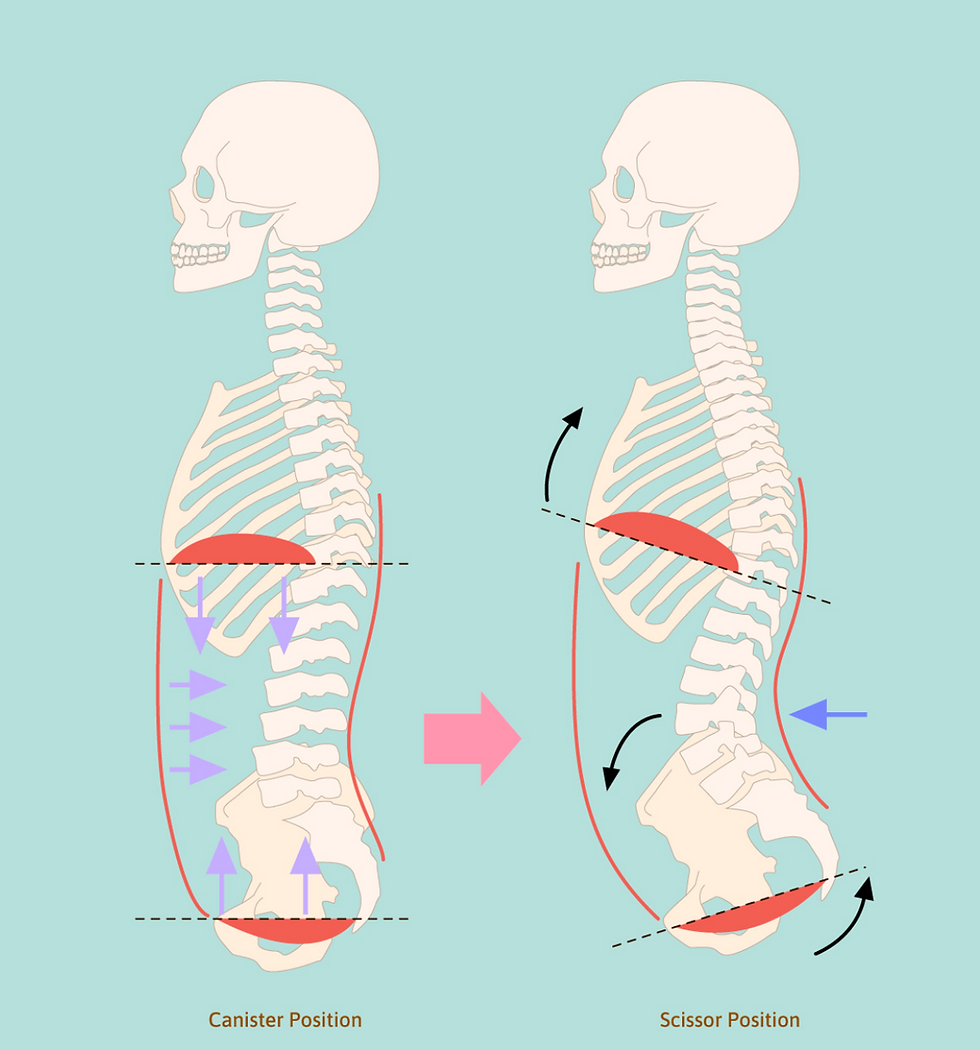
The torso on the left in the above image shows a stacked core, aligning the ribs over the pelvis and allowing you to push out on your back rather than feeling it pull in.
A common mistake is over-lifting the chest (see the skeleton on the right side of the above image). It feels strong, but what usually happens is the ribs flare, the lower back overextends, and the brace becomes shallow. You might feel tight, but you’re not actually creating useful pressure.
Sembera et al. (2023) highlights how abdominal bracing affects respiration during lifting tasks, reinforcing the role of the diaphragm in stabilisation. If the trunk isn’t stacked, that contribution is reduced.
How to Brace – A More Detailed Explanation
A common cue is “take a big breath and push your stomach out”. That cue isn't wrong, but it also doesn't fully capture what we are looking for. Another one you may have heard is Dave Tate saying, when recounting stories about Louis Simmons, “show me how fat you are”. Similar to the first cue, it could be incomplete for some, but for the lifters as West Side Barbell, they knew it didn't just mean push out your belly, it meant push out all around.
A good brace is not just forward expansion. It’s 360 degrees, you should feel pressure building into the front, sides, and back, basically all around your core.
One of the simplest ways to approach it is to think about expanding into where a belt would sit. Even without a belt, that gives you a target. The goal is to create even pressure all the way around the trunk.
A practical sequence might look like this:
• Take a controlled breath in through the nose.
• Expand through the midsection in all directions.
• Lock the ribcage down, closing the gap between sternum and pelvis (like you are preparing to be punched in the gut.
• Maintain that pressure in your core, NOT in the mouth.
The result should feel solid and stable, and sustainable. When bracing you should feel controlled and not like you have so much pressure up top that you have to rush or you'll pass out.
The brace needs to be maintained throughout the lift, if the pressure disappears as soon as you descend or when you come up, the brace wasn’t properly established.
The Role of the Belt
One of the most common mistakes early on is thinking that the belt that holds you together, and you need to get it as tight as possible. You don't!
What the belt does is give you something to brace into by providing external resistance, it allows you to generate higher levels of intra-abdominal pressure (≈20% increase ) and trunk stiffness than you could on your own. That’s why it often feels like an instant strength increase when used correctly. Stuart McGill et al. (1990) demonstrated that belts significantly increase intra-abdominal pressure and alter trunk muscle activation during loaded squats, while Harman et al. (1989) showed a reduction in spinal compression under load. In layman's terms, proper use of the built is both stronger and safer.
One useful teaching method for learning how to properly use a belt is the towel approach. Placing a towel between the abdomen and the belt increases the space you need to fill, which forces a more complete expansion. Lifters who rely on pushing purely forwards will struggle with this initially, as just pushing forward won’t compress it properly and the towel can still feel loose. In order to actually compress the towel, you must expand forward, sideways (obliques), and backward (into your lower back), giving you 360° expansion. This technique is also used in “belt stuffer deadlifts” where you perform a similar action of stuffing the front of the belt increasing the space the core must push into. Often this results in instant improvements by giving the core something to brace against, allowing for improved spinal stability and higher force transfer from the legs.
It’s not something you’d use all the time, but it’s a good way of reinforcing what a full brace should feel like.
The effectiveness of the interaction between your brace and belt has been shown to be influenced by belt construction, with Kingma et al. (2006) highlighting that more rigid, non-expanding belts produce greater increases in intra-abdominal pressure. So if you're wondering if it's really worth buying a proper powerlifting belt vs. just using the easy available and cheap flimsy belts, you don't just have to rely on bro advice, the literature supports (yes this is a bit of a dad joke/pun) it.
Ultimately, the belt doesn’t replace bracing, it enhances it. If the brace isn’t there to begin with, the belt won’t fix it.
Does it really improve performance?
The evidence backs it up all the way. I've referenced some studies in the sections above, but here are some more papers that satisfy a slightly deeper look into what I have previously covered.
Tayashiki et al. (2016) found that abdominal bracing training improved both trunk strength and lower limb power output. Combined with findings from Blazek et al. (2020) on pressure generation and Coenen et al. (2017) on movement changes, the evidence in unequivocal. It shows us that the brace isn’t just a passive structure improvement it plays a direct role in force production. Bracing not only allows us to transfer force but actually increases the amount of force in the first place. A more effective brace leads to a more stable body, and a more stable body allows for greater force to be transferred into the bar.
In practical terms, that usually shows up as lifts feeling more controlled, more consistent, and ultimately stronger (i.e. more kilos added to your total!).
Is bracing just mechanical? Dr Sophie Evelyn explains!
In strength sports, what most people casually refer to as “bloating” isn’t always a negative thing. When it’s controlled properly, it could be a useful physiological state that can be paired with the above.
What you’re typically seeing is a combination of increased glycogen storage, intracellular fluid retention, and a degree of abdominal fullness. Together, these contribute to improved tissue hydration, better leverage, and greater overall stability under load. When carbohydrate intake is increased appropriately, glycogen is stored alongside water, there is an arbitrary 3g of fluid per 1g of carbohydrates but there are too many variables that may influence this figure in our context so we’re going to give that as a very loose figure. That additional fluid within the muscle belly doesn’t just aid in the aesthetic fullness, but it can imperatively change the mechanical properties of the whole body.
More hydrated tissue generally tolerates load better; transfers force more efficiently and provides a more stable base for bracing. So, aye, feeling a bit “full” going into a session or competition isn’t something to panic about. In many cases, it’s exactly what you want.
However, there’s a very clear line between useful abdominal distension and just being an absolute wally & justifying a bout of overeating by turning yourself into a bit of a balloon. Once you tip too far the other way, things can start to work against you.
Excessive bloating, particularly from poorly tolerated foods, can lead to increased gas production, delayed gastric emptying, and general discomfort. That introduces a level of unpredictability into the system, and when you’re trying to create a consistent and repeatable brace, unpredictability is the last thing you need. Too much pressure held in the wrong places can interfere with diaphragmatic function, disrupt your ability to brace effectively, and leave you feeling like your head is about to pop before you’ve even started the lift.
Your food selection and structure are absolutely imperative to getting this right. Using a combination of carbohydrate sources allows you to control how that “full” feeling is created. Rice-based carbohydrates tend to be low in fibre and FODMAP content, digest predictably, and allow you to increase glycogen and fluid levels without excessive gastrointestinal stress (broad statement I know, but in my anecdotal experience, I believe this to be true 95% of the time). Pasta and other grain-based carbohydrate sources, particularly when paired with dietary fats, provide a slightly more ‘gradual release’ of energy.
By combining these sources, you create a more stable digestive profile, reducing the likelihood of rapid bloating or excessive fermentation while maintaining a consistent supply of substrate. From a practical standpoint, the aim is controlled abdominal filling rather than uncontrolled bloating. You want to feel full, stable, and well-fuelled, without compromising comfort or your ability to breathe and brace effectively.
Ultimately, bracing isn’t just about air. It’s about creating a system that is predictable, repeatable, and capable of handling load under pressure. If your internal environment is inconsistent, it doesn’t matter how good your setup looks, it’s going to fall apart when the weight gets heavy. And if your brace feels different every session, it might be worth looking at what you’re eating before you start blaming your £200 belt that you may just not be able to use effectively.
Final thoughts
Bracing is often treated as a small part of the lift, something you do quickly before you start moving, with far greater attention given into generating force. But if you take the time to perfect it, the payoff can be massive.
Great bracing equals safer, more consistent, and stronger lifting.
It’s not the most glamorous part of training, pushing our bellies out rather than showing off our incredible abs (which all of us have, even if some have a few more layers of insulation that others). Spend the time to understand it, practise it properly, and build it into your setup as a fundamental and automatic piece of the puzzle.
And don't just use it for the big lifts, even small accessory lifts can see power gains when you apply bracing.
Science Yo!
- Goldish GD, Quast JE, Blow JJ, Kuskowski MA. Postural effects on intra-abdominal pressure during valsalva maneuver, https://doi.org/10.1016/0003-9993(94)90037-X. (https://www.sciencedirect.com/science/article/pii/000399939490037X)
- Blazek D, Stastny P, Maszczyk A, Krawczyk M, Matykiewicz P, Petr M. Systematic review of intra-abdominal and intrathoracic pressures initiated by the Valsalva manoeuvre during high-intensity resistance exercises. PMID: 31938009; PMCID: PMC6945051.
- Sembera M, Busch A, Kobesova A, et al. The effect of abdominal bracing on respiration during a lifting task: a cross-sectional study, https://doi.org/10.1186/s13102-023-00729-w.
- Coenen P, Campbell A, Kemp-Smith K, O'Sullivan P, Straker L. Abdominal bracing during lifting alters trunk muscle activity and body kinematics, https://doi.org/10.1016/j.apergo.2017.04.009. (https://www.sciencedirect.com/science/article/pii/S0003687017300959)
- Tayashiki K, Maeo S, Usui S, Miyamoto N, Kanehisa H. Effect of abdominal bracing training on strength and power of trunk and lower limb muscles. PMID: 27377782.
- McGill SM, Norman RW, Sharratt MT. The effect of an abdominal belt on trunk muscle activity and intra-abdominal pressure during squat lifts, https://doi.org/10.1080/00140139008927106. (https://www.tandfonline.com/doi/abs/10.1080/00140139008927106)
- Harman EA, Rosenstein MT, Frykman PN, Nigro GA. Effects of a belt on intra-abdominal pressure during weight lifting. PMID: 2709981.
- Kingma I, Faber GS, Suwarganda EK, Bruijnen TBM, Peters RJA, van Dieën JH. Effect of a stiff lifting belt on spine compression during lifting, https://doi.org/10.1097/01.brs.0000240670.50834.77.


Comments